Alright, I didn’t plan this… but my portfolio accidentally turned into a test lab for my own design system 😅
I’ve been trying to build what I call an “agentic” design system — not just components, but something that can describe itself, track its own issues, and eventually be queried.
And somewhere along the way:
I’m not just building a system… I’m dogfooding it.
It started simple
At first, it was just:
- tokens
- components
- a design system page
Then I added system.json.
It’s a structured file that describes the system:
- components
- tokens
- pages
- issues
Kind of like:
a system keeping notes about itself… in a machine-readable way
And that changed everything.
Then reality hit
As I kept building (with AI helping), things got messy fast:
- docs ≠ UI
- components missing from documentation
- tokens drifting
- duplication everywhere
Pretty normal for design systems.
But AI made it happen faster.
Working with AI is fast… until it isn’t
My setup:
- ChatGPT → planning
- Claude Code → implementation
At first, it felt magical.
But once I cared about details:
- I started digging into CSS myself
- fixing issues manually
- sometimes not even asking Claude
Because:
it’s often faster to fix than to explain
And vague prompts?
👉 Always come back with surprises 😅
So I changed how I work
I added a CLAUDE.md rulebook:
- don’t invent tokens
- don’t rename values
- no hardcoded styles
- always check source of truth
Then I made that source of truth explicit.
Then I made the system review itself
I created /review-ds — a design system audit step.
It checks:
- token usage
- hardcoded values
- accessibility
- duplication
At first, it was just a checklist.
But there was a problem.
The problem with audits
They go stale immediately.
Fix something → outdated
Add something → incomplete
And once it’s outdated:
👉 it’s useless
So I connected everything
Instead of just reviewing…
I made the system log results into system.json
(the same file that powers the UI)
So now:
- issues are logged
- decisions are logged
- fixes are logged
And they show up directly on the site.
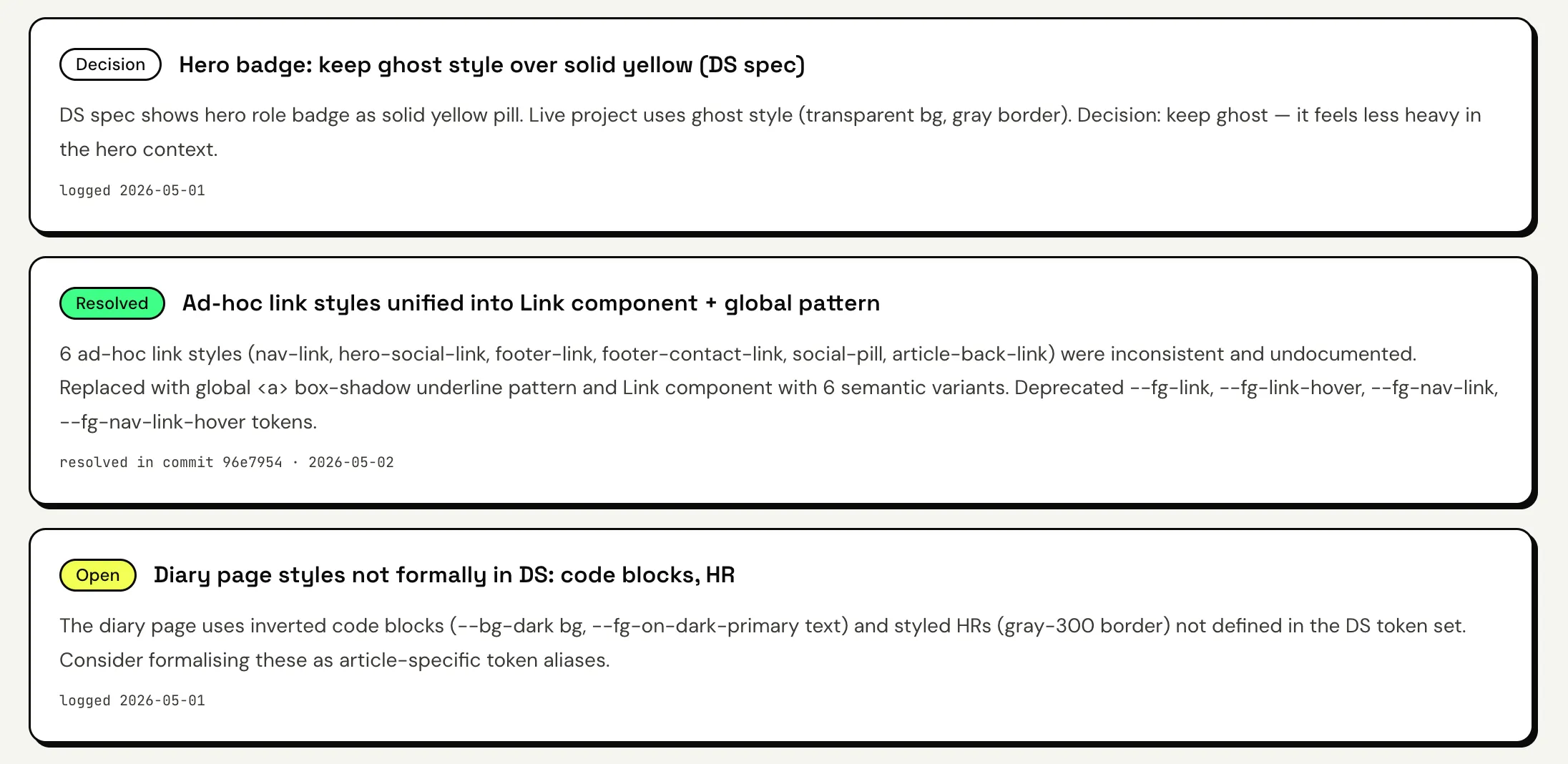
The loop now looks like this
build → review → log → render → repeatThat’s when it clicked
I stopped thinking:
“I need to keep this clean”
And started thinking:
“The system should keep itself honest”
Even the structure wasn’t safe
I split the system into:
- Foundations (rules)
- Components (implementation)
And still had:
- components leaking into foundations
- duplication
- misplaced content
So I had to enforce:
Foundations = rules
Components = implementation
The missing layer
system.json now sits between:
Code → system.json → UIWhich means:
- no guessing
- no relying on memory
- everything is explicit
👉 understandable by both humans and machines
What this changed for me
- documentation always drifts unless tied to data
- systems shouldn’t rely on memory
- AI doesn’t remove structure problems — it exposes them
- automation isn’t about speed, it’s about honesty
Where this is going
Next:
- a dashboard to see system health
- “Ask Pocky” to query the system
Final thought
This started as a portfolio.
Now it feels like:
a system that’s learning how to explain itself
If you’re building a design system
Next time you fix something:
👉 don’t just fix it — log it
That alone changes how your system evolves.